|
Australian countertenor David Hansen’s first solo CD, Rivals: Arias for Farinelli & Co, is an exciting collection of long-forgotten arias from the Baroque period. The selection has been perfectly chosen to showcase his lyric-coloratura voice and his deep understanding of the music of the Baroque period. 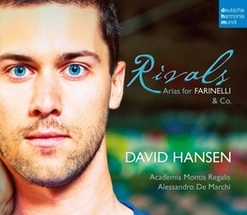 Rivals: Arias for Farinelli & Co. Rivals: Arias for Farinelli & Co. Rivals is dominated by the composer Leonardo Vinci, who had the ability to create both stunningly beautiful and fiercely energetic music with the most simple compositional devices. The other composers featured are Leonardo Leo, Giovanni Battista Bononcini and Riccardo Broschi. The arias included were all written for some of the most famous castrati of the day: Farinelli, Caffarelli, Carestini, Bernacchi. Now, thanks to performers such as Hansen, Bartoli, Fagioli and Kermes, these soprano-tessitura arias are again coming to light, wowing audiences both in the concert hall and on disk. The first aria, “In braccio a mille furie” from Vinci’s Semiramide riconosciuta, is a whirlwind piece, with a high tessitura and runs which move through the whole of the range. Hansen’s laser-like voice is effortlessly clear and on pitch in the high register. Hansen creates a palpable sense of urgency in the B-section, while his ornamentation in the da capo coruscates across the intense accompaniment provided by Alessandro de Marchi and the Academia Montis Regalis. The second aria from Vinci, “Sento due fiamme in petto” from Il Medo, showcases Hansen’s excellent support and technique, as he moves through the languid phrases with grace and tenderness. His pause on the leading note at the end of the cadenza at the start of the da capo is sublime. Two more arias come from Vinci’s Il Medo. “Non è più folle lusinga” is a slow aria with a very scaled-back accompaniment, which leaves Hansen’s voice exposed, particularly in the high register. His tone is never squeezed, always restrained and fully supported. The tessitura of “Taci o di morte” is firmly in the alto range, and here Hansen shows his technique in the lower falsetto register and the modulation in and out of the modal voice over the course of a legato phrase. The final offering from Vinci is “Risveglia lo sdegno” from Alessandro. This is a foot-stomping extravaganza, complete with horns and timpani, Hansen positively revels in the coloratura and arpeggios, powering through them with a truly heroic sound. Leonardo Leo is represented by two arias. The first, “Talor che irato è il vento” from Andromaca, contains Leo’s trademark leaps to A5 and B5, and long phrases which leap throughout the range, which Hansen execute with frightening ease. “Freme orgogliosa l'onda” from Demetrio is a hellishly difficult aria, with several awkward intervals, a phrase consisting of octave leaps up to and down from B5, and many transitions into the low register. This is definitely one of the best arias on the CD. Bononcini’s “Cara Sposa” from Griselda is a typical love aria of the period. Hansen’s voice floats ethereally above the continuo, and weaves like a gossamer thread through the accompanying upper strings. But the highlight of the album is Broschi’s “Son qual nave”. This version, which was rediscovered in an archive in Vienna, has Farinelli’s own ornamentation marked in his own hand, and Rivals presents it as a world premier recording. It also includes two horns, a completely new B-section, and several changes to the composition of the A-section for both voice and orchestra. With an astounding range, unending lines of coloratura, and many rubato phrases, this is most definitely a show-stopping extravaganza of an aria, and a true indication both of the vocal prowess of the castrati, and of Hansen.  David Hansen, countertenor
0 Comments
The new CD from Naïve records is a stunning collection of arias written for the star castrato Caffarelli. Performed by the Argentinian countertenor Franco Fagioli and Il Pomo d'Oro, led by Riccardo Minasi, it is packed with world-premier recordings. 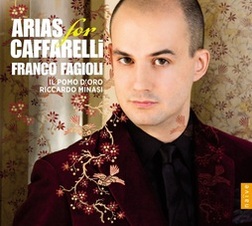 Arias for Caffarelli Arias for Caffarelli The CD begins with the astonishing “Fra L'orror Della Tempesta” from Johann Adolf Hasse’s Siroe. Fagioli’s formidable virtuosity is on display from the onset, ascending the first of several A5’s at the beginning of the second phrase. The punishing tessitura would be unmanageable for many singers, yet Fagioli seems to revel in the high phrases. His navigation of the four consecutive trilled A5’s in the A section is a delight to listen to. In the second Hasse offering, “Ebbi Da Te La Vita”, Fagioli’s incredible legato and support come to the fore, each phrase handled tenderly. From the opening fanfare of Vinci’s “In Braccio a Mille Furie” it is clear that this aria is going to blow the listener’s socks off. Fagioli spins a furious dance across nearly two octaves, running seamlessly from D4 (the only note Fagioli modulates into the modal voice to sing) and A5 and B5. Leonardo Leo’s “Misero Pargoletto” is a tense, atmospheric piece, which Fagioli performs with intelligent choices in both dynamics and tempi. By sustaining a slow pace throughout the aria, he envelops the listener in the fluidic texture of the composition, in a similar mannaer to Bartoli in arias such as “Sposa, non mi conosci”. More fireworks abound in the frenetic “Un cor che ben ama” from Domenico Sarro’s Valdemaro. Mention must be made of the spectacular virtuosity of the trumpet playing in the aria. The maturity and depth in Pergolesi’s “Lieto cosi talvolta” is apparent from the opening few bars. Following the showy spectacle of the previous aria, “Lieto cosi tavolta” allows us to admire Fagioli’s ability to turn the simplicity of Pergolesi’s line into a masterclass of breath-control, technique, and beautiful, exposed high notes.
In “Sperai vicino il lido”, Leonardo Leo alternates between pensive slow phrases, and speedy virtuosic passages. Fagioli navigates these changes well, with some stunning register shifts as he masterfully dominates the aria’s wide vocal range. By far the most elegant aria on the album is the pensive “Rendimi più sereno” by Cafaro. Fagioli plays on the pastoral feel of the aria, weaving a sumptuous fabric of tonal colour and phrasing. The showy and ebullient “Passaggier che sulla sponda” by Porpora has Fagioli leaping across his vast vocal range with tremendous precision and impeccable tonal integrity. Beginning with a beautiful messa di voce, the high tessitura of Manna’s “Cara ti lascio, addio” is a showcase for Fagioli’s tremendous and well supported high falsetto range. His light touches on the dissociated high notes in the longer phrases are deliciously tender, never resorting to breathiness or tightening the tone. Finally, as if to rid the listener of any doubt to Cafferelli’s supreme skill and obvious dominance in the Baroque world, Fagioli finishes the CD with the astounding “Odo il suono di tromba guerriera”, also by Manna. Sailing up to a B5 in the first minute and a half, the whole aria is a stunning finale showcasing the sheer breadth and stamina of Fagioli’s voice. The da capo sees him descend to a fierce E3 in the modal voice, which seems more like a contralto’s lower register than the “second voice” of the countertenor, and soar up to D6 (A-415) in the final cadenza. This is a must have for any countertenor fan, and an amazing addition to the collections already existent which form part of the ongoing Baroque music revival. With this fantastic CD, Fagioli does indeed redefine the capabilities of the countertenor voice. 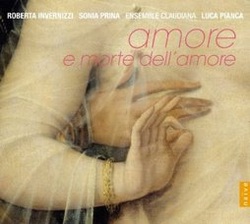 Amore e Morte dell’Amore Amore e Morte dell’Amore Naïve Records have struck gold with this stunning collection of early music songs. With music from Monteverdi, Handel, Scarlatti and others, this CD has the perfect combination of sublime, tender phrases with fast, exhilarating coloratura. Performing the works are the renowned early music specialists Sonia Prina (contralto) and Roberta Invernizzi (soprano). Both women are known for their intelligent and well researched performances, and for their formidable vocal athleticism. Accompanying them are the Ensemble Claudiana, lead by Luca Pianca, who will be accompanying Sonia Prina at her Wigmore Hall concert on 30th Dec. The CD is dominated by the giant figure of Monteverdi. The opening duet, "Interrotte Speranze" is from the Seventh Book of Madrigals published in 1619. The opening unison phrase by Invernizzi and Prina, is followed by a sinuous, snake-like intertwining of voices, as the soprano and the contralto dance around each other in close harmony. The decision to let Prina’s penultimate “mio” hang in the air, pausing before Invernizzi’s entrance on the final phrase, adds powerfully to the drama of the piece. Another piece from the Seventh Book of Madrigals is “Ohimè, dov’è il mio ben” and “vorrei bacarti”. “Ohimè, dov’è il mio ben” is split into four parts. The end of the first section sees Prina’s contralto scored above Invernizzi’s soprano, adding an interesting texture. In the third section, Invernizzi floats a gorgeous pianissimo Eb5 on the phrase “in me più che’l”, while the final section saw Prina descend to rock solid G3 on the word “morte”. 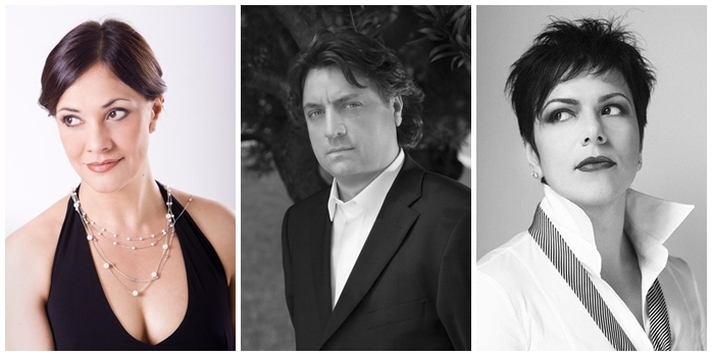
Roberta Invernizzi (Soprano), Luca Pianca (Archlute), Sonia Prina (Contralto)
The highlight of the CD is the magnificent “Pur ti Miro”, the closing duet from Monteverdi’s operaL’incoronazione di Poppea. In the A section, Prina and Invernizzi are the epitome of sensual tenderness, their voices dancing playfully and skilfully through Monteverdi’s tender music. Check out the immaculate semitone dissonance on the phrase “più non peno/più non moro”.
"Mentre vaga Angioletta" comes from Monteverdi’s Eighth Book of Madrigals. After an extended solo entrance by Prina, she and Invernizzi alternate between exquisitely precise coloratura, and haunting chromatic lines reminiscent of Purcell. The sublime moment of the piece comes on the phrase “mormorando in basso, e mobil suono” as Prina and Invernizzi sing in close harmony, crossing parts every second note. The execution of the broken coloratura on the phrase “hor la raffrena” is again testament to the skill of the two performers. The other “big gun” on the CD is Handel, represented with two duets. “Tanti strali”, sees Prina exercise her wonderful lower register, with a couple of phrases in the third section lying almost exclusively below the stave. The middle section of the duet is indicative of Handel’s melodic and harmonic genius, with several spine-tingling suspensions, and a novel resolution on the words “arsa e consunta”. The interplay between Prina and Invernizzi is perfectly measured, with Invernizzi producing several beautiful highpianissimi. The CD also features one aria each by Marcello, Lotti, and Durnate, and a sonata by Domenico Scarlatti. Luca Pianca and the Ensemble Claudiana are exemplary throughout the recording. Pianca’s well researched and intuitive direction brings out the best in all the performers, and brings to the fore aspects of the two major composers which would otherwise have been lost. His use of dynamics to emphasise certain words and structural parts of the compositional texture is genius, and works particularly well given the “stripped down” quality of the accompaniment. Amore e morte dell’amore is a "must have" this summer. |
Archives
October 2014
Categories
All
|
 RSS Feed
MOST VIEWED POSTS

The "Maggot from Italy's Tomb?" The "Black Widow" of St Bartholomew? Or one of the finest examples of power politics and survival ever seen? Well, I would have to say yes to all of the above, and more! Catherine was one of the most complex characters in a time of massive internal strife in France, with enemies both within (Guise, D'Albret) and abroad (Philip II of Spain).
|
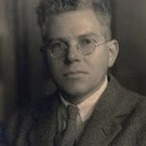
Born in Kent Town, Adelaide, Australia, Mark Oliphant was a Physicist, who received the prestigious Hughes Medal (other recipients include Alexander Graham Bell, Enrico Fermi, Stephen Hawking, and Andre Geim). He was also a life-long vegetarian after seeing a pig slaughtered at a farm as a child.
|
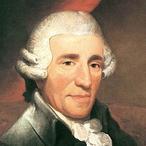
The third movement of Haydn's Cello Concerto in C Major is one of my favourite pieces of music. It is a truly joyous piece, and one which I find uplifting. The first performance I heard was by 13-year-old Han-na Chang, who took my breath away with her skill, musicianship and dynamism.
|
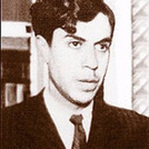
New research from Dutch scientists has revitalised the search for the elusive Majorana Fermion. The Majorana Fermion was first predicted about 75 years ago by Italian scientist Ettore Majorana, one of the Via Paspernera Boys - a group of scientists named after the street where their lab was located.
|
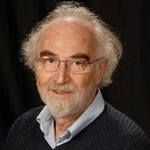
Water. Without it, we would not exist. Covering nearly 71% of the world’s surface, it is one of the key building blocks of life on Earth. We think we know all about it, how it works, and what it does. But Gerald Pollack, Professor of Bioengineering at the University of Washington, Seattle, is sure we don’t!
|
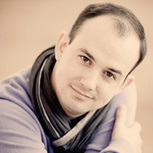
Franco Fagioli is an Argentinian Countertenor "who seems to redefine the capabilities of the countertenor voice." He has won great acclaim for his performance in the role of Arbace in the recent all-male production of Vinci's Artaserse, and will soon be releasing an album celebrating the star castrato Caffarelli.
|
© James Edward Hughes 2013