...but, as that plan has gone down the drain, I went and spent some time in one of my favourite places in London: Richmond Park.

Richmond Park, in the South West of London, is a mostly wild park with two (I think) species of Deer, and lots of interesting places to see.

I'll write a whole piece about it soon but, for now, I'll show you a couple of pics of the places I visited today.

The picture on the left is of a group of Deer near to Pembroke Lodge, near Richmond Gate. The other picture is of Isabella Plantation.
 
 
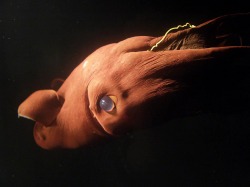
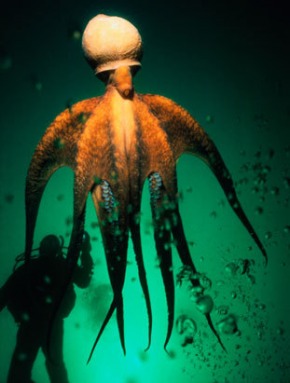
Giant Pacific Octopus, with diver. Picture by Jeff Rotman, from Getty Images. Includes octopus, diver, sea, ocean, green, orange, bubbles, giant octopus.
Giant Pacific Octopus
"Oh my hat!" said the presenter upon seeing the Giant Octopus. Oh my hat indeed!

This giant beautiful creature can live for up to 5 years, and has been know to attack sharks. The largest recorded size was 272kg with a 9m arm span, though they usually grow to about 45kg.

They are very intelligent, being able to undo sealed containers and suchlike, and can learn by observation, a trait unknown in other invertebrates. They are also extremely inquisitive: In the video you can see how the octopus investigates the diver.

Apparently, their turquoise blood is not a good oxygen carrier, hence their need to live in the cold, deep, oxygen-rich waters. They even have no less than three hearts to help pump their blood around their bodies.

For more info, try:

National Parks Conservation Association
Giant Octopus Fact Sheet

Acknowledgements:

Image: Jeff Rotman/Stone/Getty Images
Video: http://www.youtube.com/user/BBCWorldwide
 
 
DIsney Duck Tales Scrooge McDuck Huey Dewey Louie Cartoon Gold
Duck Tales
Life is like a hurricane here in Duckburg... Once this song gets into your head, it's very difficult to get it out again! So beware!

I used to rush home from school to see the adventures of ol' Scrooge McDuck, and his grandnephews, Huey, Dewey and Louie. There was always something exciting going on, and it was far more involving than a lot of newer cartoons.

Anyway, enough of me rambling: just sit back and enjoy this 'can't get it outta my head' TV Theme Tune.


Julia Hamari Contralto Mezzo Opera Oratorio St Matthew Passion Bach
Julia Hamari
I've shockingly neglected the Contralto Corner over the past couple of months, so I thought I'd get this going again by blogging about possibly the greatest aria for the voice type: Bach's Erbarme Dich, from the St Matthew Passion.

I've featured five Contraltos on this post, but the one I really want to showcase is Julia Hamari. Prof Hamari has sung the Contralto parts in nearly 30 of the Cantata Recordings made by Helmuth Rilling, and about half that amount with Karl Richter.

What is amazing about this performace is the continuity of tone and the depth of feeling Prof Hamari displays. Although she is more of a Mezzo/Contralto than a true Contralto, her lower register is powerful and full of tone. She seems to almost embody the meaning of the Aria, and at times it as if she is in another place, a vehicle for the sublime music Bach created.

More information about Julia Hamari can be seen here.

Johann Sebastian Bach Baroque Opera Oratorio Music Composer
The aria is, for me one of my favourite pieces of Bach, and also one of my top ten pieces of all time. It has such depth, spirituality and beauty that it just takes my breath away. Bach has always been my favourite composer, and I hope from this piece that you can see why.

The interplay between the Violin soloist and the Contralto is heavenly, like the human and the divine flowing around each other in a musical dance. From 2:55 to 3:10, it sounds as if the Violin is calling down, replying to the plea from the vocal line, while 3:32 to 4:25 is hauntingly beautiful. The music of this section, ending on the low note from the Contralto, has such emotion that I can't help but be drawn into the world Bach created.

4:42 to 4:58, sung here as it should be in one breath, floats majestically on the complex harmony of the strings. The music glides effortlessly, as if an out of body experience is taking place. This is then 'brought down to earth' by the sustained low tessitura of 4:59 to 5:32, which has a feeling of such desperation and longing that contrasts with the lightness of the previous part. The crescendo on the low held note from 5:18 to 5:25 especially creates this raw, earthy quality.

Finally, the ascending scale from 6:07 to 6:11 forces the music to a new crisis point, drawing us with it, until it is resolved subtily but absolutely by the final cadence (6:17 - 6:23).

This truly is a masterpiece, and has far more depth of harmony and composition that most Baroque pieces (not that I criticise the baroque period, for it is my favourite musical period).

Below is the video of Julia Hamari performing this piece.

Four more excelent Contraltos can be heard below. While they are all excellent, I particularly like the pairing of Beal and Menuhin, both at their most expressive. Each will be featured in future visits to the Contralto Corner.

Eula Beal (Contralto) & Yehudi Menuhin (Violin), in English: Click Here
Maureen Forrester (Contralto): Click Here
Marian Anderson (Contralto): Click Here
Kathleen Ferrier (Contralto): Click Here
 
 
Folkestone Beach Sea Sand Shore
Folkestone Beach
I've been a bit lazy with respect to this upload, as it is about two weeks overdue... However, it's here now. The items below are the best specimens found on my fossil hunt at Folkestone, on the south coast of England. I'm not 100% sure if I've got all the names right, so if you spot something wrong, please tell me :)

 
Euhoplites truncatus fossil ammonite folkstone
Euhoplites truncatus
The first example, pictured left, is a specimen of Euhoplites truncatus. Euhoplites is an extinct genus of cephalopod of the Ammonite sub-class. The fossils generaly date from the Middle Albian stage of the Cretaceous Period. This one was found on the surface of the shale, where there is an abundant supply of these fossils. It is a pyritised specimen.

The reason for the existence of the bumps on the side of the shell are, as yet, unknown, but may have existed to act as a slowing-down facter to stop them from going too fast in the water. E. truncatus was a small Ammonite, but there may have been differences in size depending on age and gender. Scientists have yet to confirm this.

Uhligella fossil ammonite folkstone
Uhligella
I'm not sure what this one is to be precise, but I think, from the vein-like markings on surface, that this might be a specimen of Uhligella, which is a rare Genus of Ammonite. They too date from the Middle Albian stage of the Cretaceous period, but very little seems to be known about them. It's a shame the specimen is broken, because the quality of the crenellations are very good.

R Casey states, in the Geological Magazine, that:

"Uhligella is one of the links between the Hoplitidae and their smooth Desmoceratid ancestors, and occurs typically in the Albian of the Mediterranean Province. Two new species of Uhligella found in the Middle Albian of Folkestone provide the first record of the genus in England."

Neohibolites minimus fossil belemnites folkstone
Neohibolites minimus
This one looks very much like pictures of Neohibolites minimus, also dating from the Middle Albian. It is a medium sized belemnite, caracterised by a pointy tip, a bulging section aft of the tip, and a tapering rostral end.

The Belemnites were are related to Ammonites, but also to the modern day Squid, Octopus and Nautilus. The Genus is now extinct. Their fossils are to be found in Jurassic and Cretaceous rocks, though this one was found poking nicely out of the clay :) It is normally only the guard which fossilises, however sometimes the Phragmacone, or buoyancy aid, can be found as well, though this is very rare.

The guard, at the opposite endof the head, is made of calcite. The end nearest to the head had a round opening called the alveolus. The other end tapers to a point, as can be seen in the specimen to the left.

Pyritised wood fossil folkstone
Pyritised wood
A nice example of Pyritised Wood, found laying in the shale. It has almost iron-like colourings, and is rather heavier than you would expect.


Charles Beresford Book Break-up of China
Written by Lord Charles Beresford in 1899, 'The Break-up of China' is an unprecidented analysis of the state of the trade industry in China. Beresford gives his position and affiliation  in the first paragraph of the preface:

"When I undertook the Mission confided to me by the President of the Associated Chambers of Commerce, I frankly admit that I did not fully grasp the dimensions of a problem the solving of which is only possible by clear thought and decisive action - qualities that have been conspicuously absent from our dealings with China during the late difficulties in the Far East. Although my Report deals mainly with trading and commercial questions, it cannot exclude considerations of high policy, and I am compelled to travel outside the limits originally defined for the scope of my Mission. In framing my Report it is impossible to ignore conditions inseparable from the Commercial Question - viz., matters relating to international...and political complications. The British and American public have been quite bewildered by the controversy which has raged during the last year over the relative merits of the "Open Door" and the "Sphere of Influence.""

Political cartoon depicting the Afghan Emir Sher Ali with his 'friends' the Russian Bear & British Lion (1878). Save me from my friends.
Political Cartoon: The Great Game
Obviously, when looking at the tenor of the work, one must consider the times in which it was written. At the very end of the long reign of Queen Victoria, the British Imperial mindset was still in operation. The arguement between the "Open Door" policy and the adoption of the "Sphere of Influence" (which was at work in Persia and Afghanistan during the Great Game between The Russian and British Empires) was one of the level of interference, rather than whether interference should occur at all. If, however, it is possible for the reader to look dispassionately at the information given, one will see there is a veritable minefield of facts and observations which give an insight in to not only the state of the Chinese economy, soverignty and stability in 1899, but also into the minset of the British Government, and to a lesser extent the Japanese, American and Russian governments, with respect to the state of China and its possibilities for trade and development.

The "Sphere of Influence", Beresford explains, would lead to increased foreign militarisation, and probable framentation of the Chinese Emprie, precipitation its collapse. The "Open Door" would lead to free trade (though more for the benifit of the foreign traders than for the Chinese government) and a bolstering of state integrity, though not of state choice of business partner and foreign policy. Indeed, Clarence B. Davis and Robert J. Gowen, in their abstract "The British at Weihaiwei: A Case in the Irrationality of Empire" state, with regards to the various treaties imposed on the Chinese, that these treaties:

"[k]nown to the Chinese ever since as the "unequal treaties," ...progressively infringed on China's sovereignty, administrative and legal integrity, and economic viability. Extraterritorial rights exempting foreigners from Chinese justice, treaty ports where administration was in the hands of foreigners, and foreign control of extensive portions of Chinese bureaucratic administration, including even the country's ability to collect revenue through the Maritime Customs Service—all became part of the elaborate edifice of extraordinary rights and privileges that the powers created for themselves in the name of the "great game" of empire in China."

Lord Charles Beresford
Beresford was commissioned for the report by the Associated Chambers of Commerce, whose interest was directed at the possibilities of trade both with and within the Chinese Empire. The following is a quote from the letter of the President of the ACC, the Hon. Sir Stafford Northcote, Bart., MP:

"It is generally admitted that there is a great possible field for business undertakings; but I, personally, feel some doubt as to whether the organization of the Chinese civil and military administration is sufficiently complete to insure adequate protection to commercial ventures."

For me though, it is the questions of trade and security, along with the relationship with Russia and the improvement of administration which make this book so invaluable. Given the importance that these four issues have played in the dedvelopment of China from a playground for European, Japanese and American business, to a power commanding vast amounts of capital, dominating world trade, a centralised government capable of supressing internal dissention, and the entent reached with it's neighbouring colossus, it is intersting to get a ground level view of the situation with respect to these issues from just over 100 years ago. Much has obviously changed.

Map Port Arthur Russia
Port Arthur 1912
The Russian advance on and militarisation of the northern area and Manchuria posed a significant threat to British trade interests, and it was thought by british traders at the time that:

"There can be no question that the Russians are at present in a position of tremendous military advantage in the event of anything occuring which might involve a warm arguement as to what was necessary for the proper security of British trading interests."

The building of the Russian-Manchurian Railway, aimed at consolidating the Russian hold on Port Arthur, was most definately seen as of strategic and military, rather than trade-based, importance. The issues surrounding the Shanhaikwan Railway, where Russia "refused to allow an agreement made between a British corporation and the Chinese Government to be ratified" showed how trade and development were being used as a weapon by the Russian Empire to ensure dominance in Manchuria and preferential tariffs, counter to the ethos of the "Open Door". Beresford was also at pains to give his:

"personal testimony to the statement made by British merchants...as to the dominant position of the Russians in Manchuria."

Effectively, the inability of Britain to intervene effectively in disputes between Russia and the Brtish traders, as well as its inability to aid China militarily and diplomatically to halt Russian incursions in Manchuria and northern China, diminished, in the eyes of China and the rest of the world, the standing, vigour and power of the British Empire. The annexation of Manchuria would also, it was believed:

"inevitably be the prelude of a successful march southwards towards India."

Photo President Obama USA United States of America and Hu Jintao China
Obama and Hu Jintao
The relationship between Russia and China has been of prime importance to both countries since the end of World War II, and is watched closely by the rest of the world even today. Trade between China and the world is what has pushed it to economic "World Power" status. It's ability to mobilise its workforce to produce goods at a high turn-around at low cost has made China a dominant force in world trade and economics. It is no wonder that President Obama has chosen to build greater links between the USA and China. What interests me is the change in China's position in 1899 to now. From a country that was effectively dictated to by interfering powers in terms of its trade tarrifs and partnerships, China has emerged in full control of its economic and technologic interests, and is using them to great effect in both the First and Third Worlds. One only has to look at its attempted economic intervention in Greece, ominously blocked by Angela Merkel, to see the scale to which China can affect and intervene in world financial and political questions.

Lastly, the question of security, both internal and external, has I believe been the biggest reversal of them all. From a country that, according to the Beresford report, was unable to protect itself from any of the interfering powers, nor able to protect traders internally from bandit attacks in the interior of the country, China has emerged as one of the "big three" with respect to weapons stockpiles, army size, and world influence. Beresford, in the book, warns Chinese officials of the necessity of modernising the army:

"I informed [Prince Ching] that real and effective protection could be given to property by a thorough and complete reorganization of the Chinese Army as a whole; that the present system of having provincial armies had proved itself, over and over again, ineffective; that a vast amount of property had been destroyed, and that many lives, of missionaries and others, had been sacrificed, all owing to the want of efficient military and police; that these losses of life and property had caused immense inconvenience and expense to the Chinese Government itself."

A situation that has undergone a complete reversal again since World War II, as the world is now fully aware of the scale of China's military force.

This book, then, is of primary interest with respect to the issues which, according to Beresford, would decide China's fate. Neutral or friendly relations with Russia, improved, centralised armed forces, the conrol of internal and external trade, and the proper regulation of the administrative system, has turned China from a country on the brink, to an Empire of prodigious strength and economic solidity. It is with this in mind that I read Beresford and ponder whether he knew the scale of the power latent in the sleeping Titan that was just beginning to awaken?
Resources:

Complete online copy: Click here
Complete online copy, from Questia books, with internal search function: Click here
 
 
Catherine de Medici Queen Mother France Italian French Italy History
Catherine de Medici
The "Maggot from Italy's Tomb?" The "Black Widow" of St Bartholomew? Or one of the finest examples of power politics and survival ever seen? Well, I would have to say yes to all of the above, and more! Catherine was one of the most complex characters in a time of massive internal strife in France, with enemies both within (Guise, D'Albret) and abroad (Philip II of Spain).

Born on 13 April 1519, in Florence, Italy, Catherine was the heiress to the estates of both her father, Lorenzo II de Medici, Duke of Urbino, and her mother Madeleine de la Tour d'Auvergne. They both died soon after her birth. She then became a pawn in the hands of her Papal relatives, first Leo X, then Clement VII. It was Clement that negotiated her marriage to Henry, Duke d'Orleans, second son of King Francis I of France.

Cow Dung Catherine de Medici fertility treatment
Cow Dung - Yuk!
Henry's brother Francis died, and Catherine became Dauphine. For 10 years she tried to conveive a child, and when Henry became Dauphin, the situation was all the more critical. Rumours that Henry was to repudiate her drove her to try potions, rub dung on her genitals, and drink mules' urine (thought to increase fertility at the time). She even drilled a hole in the ceiling of the room where her husband was sleeping with his long-term mistress, Diane de Poitiers, to see if there was anything she was doing wrong in the bedroom. Finally, doctors checked both her and Henry, and found an abnormality in his penis. He advised certain sexual positions, which miraculously worked, as Catherine produced ten children!

Henri II King France French History
Henri II of France
Although Henry was completely besotted with his mistress, Catherine idolised he husband the the marragethey shared. Apart from a few nominal regencies in his absence, Catherine had very little experience of direct power, as Diane de Poitiers was more in favour at court. When Henry died, during a jousting match where a lance hit him straight in the face, and splintered through his eye, into his brain, and out of his ear, Catherine was thrust into the malestrom of French politics, and the first of her regencies. Francis II, her weak and sickly son, was married to Mary, Queen of Scots. Mary's mother was Mary of Guise, regent of Scotland, and a formidable character in her own right, who was sister of the Guise brothers who now had a strangle-hold on French politics, as they had been named co-regents with Catherine during Francis' minority. It was only when Francis died, and her second son Charles IX became king, that her role as 'Queen Mother' became unassailable. There is some evidence to suggest that Catherine was not altogether sad to see her son's demise, especially as she was able to convince Charles to name her sole regent.

Jeanne D'Albret Queen Navarre Protestant Calvin Calvinist Bearn Duchess Vendome History
Jeanne D'Albret
During her reign, Catherine had to cope with the many 'wars of religion' between the ultra-Catholic reactionaries, headed by the Guise faction, and the Protestants, headed by Coligny, Conde and Queen Jeanne d'Albret of Navarre. Jeanne was fanatically Protestant, and a disciple of Calvin. Her husband, Antoine de Bourbon, was Prince of the Blood, meaning next in line to the throne after the Valois family. Once Antoine had died, it was her son Henry, who, in the event of all of Catherine's male children dying childless, would be heir to the French crown. In an inspired move, Catherine forced a marriage alliance on Jeanne, so that her son, the Protestant future Henry IV, would marry Catherine's daughter, Margaret. Just prior to the marriage, Queen Jeanne had died in what some called suspicious circumstances, apparently killed by a pair of poisoned gloves sent from Catherine. It was at the time of the marriage, however, that the most infamous event of her reign occured.

St Bartholomew's Day Massacre Queen Catherine De Medici France French History
St Bartholomew's Day Massacre
When her son, the future Henry IV, and his entourage of Protestant followers, arrived in Paris, tensions were heated as Paris was fanatically Catholic. An attempt was made on the life of Coligny, who survived, though with an amputated finger. Fearing a massive backlash, Catherine convinced her son Charles IX that a pre-emptive strike against the Hugenot leaders was necessary. His cry of "Then kill them all! Kill them all!" was more real than he would have liked: the ultra-Catholic faction and the people of Paris started to kill all the Protestants they could. The massacre spread out into the surrounding areas. Thousands died. It is not known the extent of Catherine's involvement in the massacre, but it was what lead to the "Black Legend" surrounding her from that time on.

Cosimo Ruggieri Astrologer Astrology Black Dark Magician Ocarle of the Bleeding Head
Cosimo Ruggieri
One of the accusations thrown at Catherine was the use of astrology and black magic, and her belief in omens, signs, portents and premonitions. Nostradamus was known to have prophesied for her on more than one occasion. R. J. Knecht, in his book Profiles in Power: Catherine de' Medici, states that she:

"owned a book with pages of bronze on which rotating disks represented the constellations. By manipulating them, she could easily work out the conjunctions essential to the reading of horoscopes."

She was especially diligent at this in the case of her children. She also used astrologers at court, one being Regnier, but the more famous being Cosimo Ruggieri. Ruggieri was not just an astrologer, but also a Black Magician too. In her book, Catherine de Medici, Leonie Frieda talks about some of the practices used by Catherine and Ruggieri to get rid of her enemies in the Protestant camp, in particular the use of dolls and models to torture and kill at a distance. After one battle in particular, three of the top Hugenot's were found in exactly the same position as the dolls used by Ruggieri.

Eliphas Levi Magician
Eliphas Levi
By far the most henious sorcery attributed to Catherine and Ruggieri was the Oracle of the Bleeding Head. Both Helena Blavatsky, in "Isis Unveiled", and Eliphas Levi, in "Transcendental Magic", quote Bodin's "La Demonomanie, ou traite des Sorciers" to describe the foul act of preparing the oracle. A male child, without imperfection, was chosen, and given his first communion. The black mass was prepaired, in front of the inverted cross, in the rooms of Charles IX, Catherine's sickly son. At the altar, after taking the white wafer, the head was struck from the body in a single blow, and placed:

"all palpitating, upon the great black wafer which covered the bottom of the paten, then placed on a table where some mysterious lamps were burning...the demon was charged to pronounce an oracle, and reply by the mouth of this head..."

We do not know the question allegedly asked of this oracle, but the answer given in "a feeble voice, a strange voice, which had nothing of human character about it..." was: "Vim patior" which in Latin means "I suffer violence." It is thought that this would be the king's fate in Hell for his part in the St Bartholomeaw's Day Massacre. On hearing this, he ran from the room, and died shortly after.

Enri IV King France Navarre Protestant Paris worth a mass Prince of the blood
Henri IV France
Catherine's life ended, probably dying of pleurisy, months before the assination of her last surviving son, Henry III. She had seen eight children go to the grave, her husband die, and her realm splinter and fracture under the strain of religious warfare. Yet still she managed to play off the different factions, to keep her incompetent sons in power, to marry off her daughters well, and so survive every reversal that befell her. Henry IV (Queen Jeanne's son) said of her:

"I ask you, what could a woman do, left by the death of her husband with five little children on her arms, and two families of France who were thinking of grasping the crown—our own [the Bourbons] and the Guises? Was she not compelled to play strange parts to deceive first one and then the other, in order to guard, as she did, her sons, who successively reigned through the wise conduct of that shrewd woman? I am surprised that she never did worse."

Resources:

Catherine de Medici, Leonie Frieda: http://www.leoniefrieda.com/review.htm

Catherine de' Medici, R. J. Knecht: http://www.h-net.org/reviews/showpdf.php?id=2778

© James Edward Hughes 14/04/2010
 
 
Mysterious Cities of Gold cartoon Condor
Yeah, you remember that cartoon. Aaaaah ah ah ah ah, some day you will find the Cities of Gold. What great fun that was. They truly don't make kids cartoons like this anymore. Mysterious Cities of Gold was one of my favourite cartoons from the '80s, and I'm glad I found the theme to this fantastic show.

I can't remember if they ever got there, but I just loved the giant Condor from the opening theme. Sit back and enjoy, and perhaps even relive a little bit of your childhood.


Hey everybody, thanks for your continued support as I try and get this site finished.

I've added new pages now, about the places I've been in the world. The first of the reports, this one about the Ice Hotel in Sweden, is ready to view. There will be more on the way.

Thanks,

James

Travel
My Favourite Excursions
Sweden: The Ice Hotel
 
 
Picture of titan from www.nasa.gov
Titan (www.nasa.gov)
One of the things which most fascinated me as a child was the moon of Saturn known as Titan. Back then, relatively little was know about Titan but, with the Cassini/Huygens mission, far more is known about this enigmatic moon.

Titan, a cold little place at -180C, has many interesting features which make this moon stand out from the crowd. It is bigger than Mercury and Pluto, and it's atmosphere is thcer than that of the Earth. It's core is rock, or possibly a rock and iron mix, its mantle and crust composed mainly of water, and ots surface a thin layer of hydrocarbons. Scientists think that, under the mantle, there may even be an ocean of water and ammonia.

On Earth, the stratosphere is composed of Ozone, and it is this which soaks up the solar radiation. On Titan, the stratosphere is composed of hydrocarbons. This haze, which characteristically surrounds the planet, was originally thought to be made up of lighter hydrocarbons, such as ethane. Since Huygens, however, we now know that there are much heavier compounds there, such as benzene.

This abundence of hydrocarbons is important because scientists now believe that methane plays the role of water on Titan. The temperature of Titan is close to the triple point of methane (the point where the solid, liquid and gaseous phases can co-exist) just as the temperature of Earth is close to the triple point of water.

There is also possibilities of a hydrologic cycle, though one far more extreme than that of Earth's, which has centuries of drought interspersed which massive downpours. Cassini observed areas ofthe surface of Titan darken after clouds passed over, suggesting rainfall. According to Ralph Lorenz and Christophe Sotin of Scientific American: "Titan is to the hydrologic cycle what Venus is to the greenhouse effect: a terrestrial process taken to extremes."

Some further reading:

www.scientificamerican.com - March 2010 issue: The moon that would be planet (you must either buy the issue or subscribe to get the full article)
http://solarsystem.nasa.gov/planets/profile.cfm?Object=Sat_Titan - Nasa site: Titan
http://www.esa.int/SPECIALS/Cassini-Huygens/SEMKVQOFGLE_0.html - Cassini/Huygens mission with video of the landing on Titan
http://saturn.jpl.nasa.gov/index.cfm - The Cassini Mission
http://www.lpl.arizona.edu/~showman/publications/mitri-etal-2007-lakes.pdf - Hydrocarbon Lakes on Titan